
You can pass your GED in one month. Thousands of Onsego students have already done it. With the right plan and focused effort, you can earn your diploma in 30 days or less.
This guide walks you through exactly how to do it, whether you choose Onsego’s Pro plan with Fast Mode, the standard self-study path, or a DIY approach using free resources.
Why This 1-Month Plan Works
The key to passing the GED quickly is a strategic preparation plan, not just studying more hours.
Get your GED Diploma Quickly
With Onsego, it’s simple and easy
Getting a GED in one month requires commitment. The GED test is not hard, but it is specific and requires preparation.
You also need to study actively. Watching videos or reading a textbook passively gives you a false sense of progress. Active learning builds the confidence you need to pass. That means:
- Quizzes after every lesson
- Flashcards to reinforce key concepts
- Practice tests in the actual GED format
Onsego’s courses are built around active learning. Each short video lesson is followed by a quick quiz, flashcards, and multiple types of practice tests. You apply what you learn immediately, which is what makes the accelerated timeline realistic.
How Fast Could You Get Your GED?
Take an 8-question quiz
Three Ways to Approach This
You have three options for your one-month GED plan:
- DIY: Build your own study schedule using free resources and official practice tests. The main challenge is knowing what to study. It works best if you left school recently and were a strong student. Official practice tests will tell you if you are ready. Like with everything, DIY can work well or you can end up disappointed.
- Onsego Online GED classes-Self-Study: A structured course with active practice tools and four free GED Ready vouchers. There is no built-in acceleration here. You take Onsego’s standard program and compress it yourself to fit the one-month timeline.
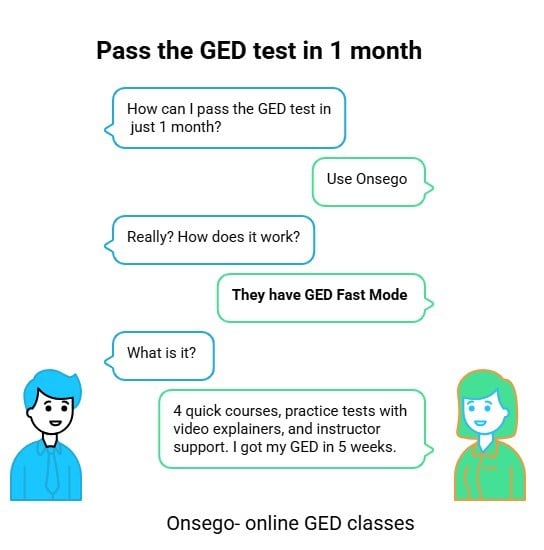
- Onsego Pro with Fast Mode: Adds instructor feedback and an accelerated subject-by-subject program that gets you to a passing score as fast as possible.
This guide covers all three. If you want to go the DIY route, you will find it in the section at the end.
Choose Your Onsego Study Path
Option 1: Self-Study with Onsego
This is the standard plan. It works well, but there is no built-in accelerated schedule. You take the standard Onsego program and compress it yourself, combining two study days into one to fit the one-month timeline. You get full access to:
- All lessons, quizzes, and flashcards
- Multiple types of practice tests
- Four free GED Ready vouchers
Option 2: Onsego Pro with Fast Mode
This plan includes Fast Mode, a set of four accelerated programs, one per subject, designed to get you test-ready as fast as possible. Here is what you get:
- Instructor review of your practice test scores
- Specific feedback on your easiest areas to improve
- A clear action plan before you schedule your real test
Most students are ready to schedule their test within a day or two of completing the program.
Both plans include a 4-payment Klarna installment option.
Study Guide: GED in 1 Month with Fast Mode
Fast Mode is built for speed. Each subject has three modules with about 25 lessons and short quizzes. You learn the core material first, then move into an intensive practice test sequence.
How the Fast Mode Practice Sequence Works
- Video explainer practice questions. These walk you through each question, show you how the GED frames problems, and teach elimination strategies. Each video includes a knowledge refresher, so you are reinforcing content as you practice.
- Build Your Skills (BYS) practice tests. These check what you have learned before you go full-length.
- Timed, full-length practice test. When you finish, you receive a score report and your instructor emails you with identified quick wins.
You act on that feedback, then schedule your GED Ready or real GED test.
The schedule for each subject is five days:
- Days 1 to 2: Video lessons
- Days 3 to 5: Practice tests
- Day 5: Instructor feedback
Week 1: Social Studies
Start with Social Studies. It is the most accessible subject for most students and a good way to build confidence early.
- Follow the five-day study plan in your account
- Study two to three hours per day
- On day six, take the GED Ready practice test
- Score in the green zone, then schedule the real test
You can take the GED test online at any time of day, so scheduling is flexible.
Week 2: Language Arts
Language Arts builds directly on the reading skills you practiced in Social Studies.
What the test covers:
- Five to six long passages, typically around 300 words each
- Main idea identification, drawing conclusions, and making inferences
- Grammar: parallel sentence structure and modifiers appear regularly
Fast Mode gives you enough practice to sharpen all of these. Follow the same five-day schedule.
Week 3: Science
Science on the GED tests your ability to read graphs, interpret data, and apply basic scientific reasoning. You do not need to memorize a textbook’s worth of facts.
Fast Mode covers:
- Key process-of-science topics
- Graph and data interpretation
- The math that shows up in science questions
Same schedule: five days.
Week 4: Math
Math takes a bit longer than the other subjects, typically seven to ten days, because there is more to set up.
Your Math Fast Mode plan:
- Budget two to three hours to learn the TI-30XS calculator
- Learn the STO method, STO with helpers, and the Table method
- Apply these techniques to geometry, algebra, and word problems
Because you are using a calculator throughout, math is more accessible than most students expect. The extra days are for building fluency, not fighting through hard content.
When you finish each subject and earn a passing score of 145 or higher, your state will send you your diploma.
Study Guide: GED in 1 Month with Standard Onsego
The GED includes four subject tests. You can take them in any order. Most students start with Social Studies or Language Arts, but choose what feels most approachable for you.
The goal is one subject per week. Each week follows the same three-step structure.
Step 1: Take the “Can I Skip It?” Diagnostic Test
This 10-question test assesses your knowledge of each module before you start it.
- Score 70% or higher: skip that module and move forward
- Score below 70%: complete all lessons in that module
This keeps you from wasting time on material you already know.
Step 2: Use the Accelerated Study Schedule
Onsego’s standard planner is two weeks per subject. To finish in one month:
- Compress each two-week plan into seven days
- Combine two study days into one
- Study two to three hours per day
Step 3: Complete Each Module
Each module includes 10 to 16 lessons. Every lesson includes:
- A short video
- A written transcript
- A five-question quiz
At the end of each module, take the comprehensive practice test.
Weeks 2 through 4
Repeat the same process for each remaining subject. Many students save Math for last. By week four, you are familiar with the test format and have built confidence from the previous three subjects.
GED Ready Practice Tests
After completing each subject, take the GED Ready official practice test. Onsego includes four GED Ready vouchers with every account, one per subject, so you do not pay the standard $7.99 fee.
- Score in the green zone: you are ready to take the real test for that subject
- Complete this for all four subjects before scheduling your actual exams
Four Subjects, Four Weeks: What You Are Studying
Here is what each GED subject covers:
- Mathematical Reasoning: Algebra, geometry, and data analysis. Onsego’s TI-30XS calculator course walks you through specific techniques that make complex problems much more manageable.
- Reasoning Through Language Arts: Reading comprehension, grammar, and an extended response essay.
- Science: Biology, chemistry, physics, and earth science. The test emphasizes interpreting data and scientific reasoning over memorization.
- Social Studies: History, government and civics, economics, and geography.
A Note on GED Math
Math is the subject most students dread. The TI-30XS calculator changes the picture significantly.
Onsego’s calculator course teaches you how to use the TI-30XS to solve problems that would be slow or error-prone by hand. The calculator is allowed on most of the math section. Knowing how to use it well is one of the most practical things you can do to improve your score.
What you learn in the calculator course:
- Core TI-30XS operations (takes about two to three hours to get fluent)
- The STO method for storing and reusing values
- The Table method for solving equations faster
- How to apply these to geometry and word problems
Tips for Passing the GED in 30 Days
- Study two to three hours every day. Consistency matters more than long cramming sessions.
- Start with the subject that feels easiest. Early wins build confidence and momentum.
- Use practice tests as your main preparation tool. They show you exactly how the GED frames questions and where your gaps are.
- If you choose Fast Mode, act on your instructor’s feedback immediately. Those quick wins are the fastest way to a passing score.
- Take the GED Ready test after each subject before scheduling the real exam.
Your 30-Day Timeline
- Week 1: Complete your first subject (Social Studies or Language Arts recommended)
- Week 2: Complete your second subject
- Week 3: Complete your third subject
- Week 4: Complete your fourth subject (often Math)
Throughout each week, take Onsego’s practice tests after each module. After each week, take the GED Ready test to confirm you are ready for the real exam.
Want Instructor Support?
With Onsego Pro, certified instructors review your progress and identify the areas where you can gain points most quickly. You get targeted feedback at exactly the right moment, not a generic study plan.
What this means in practice:
- You do not spend days re-studying whole sections
- Your instructor tells you exactly where to focus
- Most students are test-ready faster than they expected
DIY Option: Passing the GED Without a Prep Course
If you prefer to build your own plan, it is doable. Here is what you need to put together:
- Study materials: The GED Testing Service publishes free study guides at ged.com. Khan Academy covers math and science well. For language arts, focus on reading comprehension practice using long passages, since that is what the test emphasizes.
- Active practice: Passive reading is not enough. You need quizzes and practice questions to test what you are actually retaining. Build regular self-testing into your schedule from day one.
- GED Ready tests: These are the only official practice tests that can predict whether you will pass. Take one after you finish studying each subject. If you score in the green zone, schedule the real test.
- A calculator plan: The TI-30XS is the calculator used on the GED Math test. Learn it before you sit the exam. There are tutorial videos online that cover the basics. Budget two to three hours for this.
- Your schedule: Follow the same one-subject-per-week structure outlined in this guide. Study two to three hours a day. Start with your easiest subject.
The DIY route takes more planning and self-discipline than a structured course. There are a lot of free study resources out there, but it is easy to stay busy without results, meaning you pass one or two subjects but fail the rest. You do not get a GED diploma for trying.
You will not have anyone reviewing your practice scores or pointing out where you can pick up easy points. But if you are organized, motivated, and ready to accept the lack of structure, it is a legitimate path to your diploma in 30 days.
Ready to Get Your GED in 30 Days?
Thousands of Onsego students have earned their GED in one month. The plan above is specific, tested, and built around how adult learners actually retain information.
Pick your path, commit to the schedule, and take your subjects one at a time. Your diploma is 30 days away.
Last Updated on August 29, 2026