
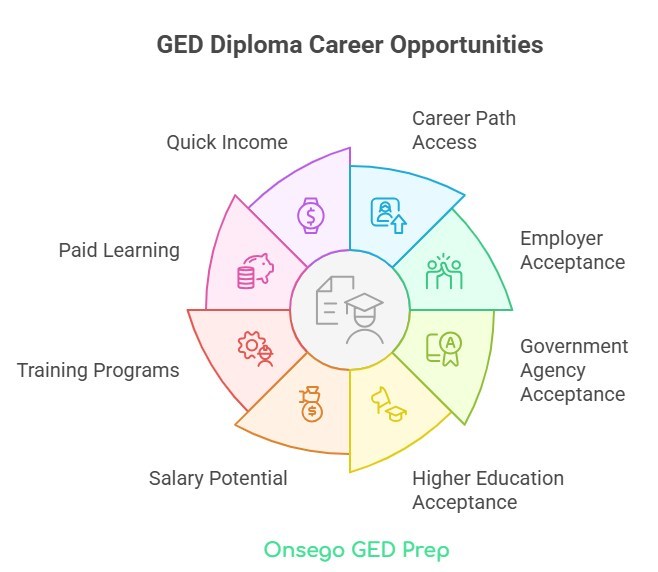
Holding a GED diploma will open many doors to a rewarding career path. The GED diploma is equivalent to a regular high school diploma.
Employers, government agencies, and institutions of higher learning accept your GED in the same way as a high school diploma.
Let’s take a closer look at 10 career paths that become available to you once you have secured your GED.
Get your GED Diploma Quickly
With Onsego, it’s simple and easy
Imagine this: You didn’t complete your high school curriculum, and you don’t have a GED. Now, you’re stuck making $12-$15 per hour.
You want to earn a higher income but don’t want to spend four years in college.
Well, here’s the good news: There are career paths that pay $45K-$70K per year with just a GED. These positions don’t require you to earn a college degree.
How Fast Could You Get Your GED?
Take an 8-question quiz
There are, for example, multiple jobs with the federal government where having a GED already qualifies you for, of course, followed by additional training while you get paid a decent salary.
The career paths listed below typically include training programs that take 3-12 months, and many offer pay while you learn. With these career paths, you can start making real money within a year.
First, get your GED (takes 4 weeks to 7 months)
Before you can enroll in any of the following programs, you need to have your GED.
Onsego’s online GED programs can be completed in 30 days (Fast Mode) or in 2 to 8 months (Advantage plans), depending on your pace. Let’s see what is included in Onsego’s Advantage Plans:
- Short video lessons that explain every GED concept in detail
- AI tutor available 24/7 to answer your questions when you’re stuck
- Real instructors review your practice essays, providing advice
- Unlimited GED practice questions
An Onsego Advantage Plan costs from $79 to $199, and the GED test will cost you $144 to $188 in most states, meaning your overall cost will be between $223 and $387.
10 career paths that open up the day you get a GED
The following well-paying jobs do not require a 4-year degree. But you will need a GED to get into a vocational-technical school!
1: HVAC Technician
The job: You will install, repair, and maintain heating, cooling, and ventilation systems. You work in homes, offices, and industrial buildings.
The pay: Starting salary: $18-$20 per hour ($37,000-$42,000 per year). After 2 years: $24-$28 per hour ($50,000-$58,000 per year). After 5 years: $30-$35 per hour ($62,000-$73,000 per year).
How to start: First, apply to an HVAC apprenticeship program. These programs pay you while you learn. You work 4 days per week and take classes 1 day per week.
Time required: 4 years to complete the apprenticeship. Cost: Free (you get paid on the job while learning).
GED requirement: All apprenticeship programs require a high school diploma or GED. No exceptions.
Real-world example: Marcus passed the GED test after using Onsego in 10 weeks. He enrolled in an HVAC apprenticeship. The starting pay was $19 per hour. After two years, he made $26 per hour ($54,000 a year). Today, he works for a commercial HVAC company with full benefits.
2: Welder
The job: You will weld metal parts together using high heat. You work in manufacturing, construction, shipbuilding, or automotive repair and must be able to read blueprints and operate welding equipment.
The pay: Starting salary: $17-$20 per hour ($35,000-$42,000 per year). After 2 years: $22-$26 per hour ($46,000-$54,000 a year). Specialized welding: $30-$40 per hour ($62,000-$83,000 a year).
How to start: First, enroll in a welding program at a technical school or community college. Some programs take 6 months, others take 1-2 years. Many employers hire you during training.
Time required: 6 months to 2 years. Cost: $5,000-$15,000 (financial aid is available).
GED requirement: Welding schools require you to have a high school diploma or GED. Be aware that programs that claim “no GED required” are low-quality and won’t place you with good employers.
Real-world example: Derek got his GED at 24 through Onsego in 12 weeks. He completed a 9-month welding program. He started at $19 an hour as a structural welder. After obtaining certification in underwater welding, he now earns $42 per hour ($87,000 a year).
3: Electrician
The job: You will install, maintain, and repair electrical systems in homes, businesses, and factories. You must be able to read blueprints, run wiring, and troubleshoot electrical problems.
The pay: Starting salary: $18-$22 an hour ($37,000-$46,000 a year). After 2 years: $25-$30 per hour ($52,000-$62,000 a year). Master electrician: $35-$45 per hour ($73,000-$94,000 a year).
How to start: First, apply for an electrician apprenticeship through a union or electrical contractor. From day 1, you’ll get paid while you learn. You will work during the day and take classes at night.
Time required: 4-5 years to become a journeyman electrician. Cost: Free (you’ll get paid on the job while learning).
GED requirement: All electrical apprenticeship programs require you to hold a GED, and the application process is quite competitive. No GED means you can’t even apply.
Real-world example: Tony got his GED in just 8 weeks using Onsego’s 6-month Advantage Plan ($79), after which he applied for a local electrician union apprenticeship. The starting pay was $20 per hour. After four years, he became a journeyman electrician, making $32 per hour ($66,000 per year). He now runs service calls and sets his own schedule.
4: Plumber
The job: You install, maintain, and repair pipes, fixtures, and drainage systems. You will work in homes, commercial buildings, or industrial facilities, and you respond to emergencies and do new construction.
The pay: Your starting salary will be $17-$21 an hour ($35,000-$44,000 a year). After 2 years: $24-$29 per hour ($50,000-$60,000 a year). Master plumbers typically earn $35-$50 per hour ($73,000-$104,000 a year).
How to start: First, enroll in a plumbing apprenticeship program. Union programs are best. You’ll get paid from day one. You learn on the job and take classes.
Time required: 4-5 years to complete the apprenticeship. The cost is free, as you get paid while learning.
GED requirement: Plumbing apprenticeships typically require a high school diploma or GED; No exceptions. If you don’t hold a GED, trade unions will not accept your application.
Real-world example: James got his GED at 30 in 10 weeks with Onsego. He joined a union plumbing apprenticeship, where his starting salary was $18 per hour. After five years, he’s now a licensed plumber making $38 an hour ($79,000 a year). He also gets calls for weekend emergency work that pays double.
5: Commercial Truck Driver (CDL)
The job: You will drive large trucks to transport goods locally or across the country. You haul freight, food, construction materials, or other products.
The pay: Your starting salary will be $45,000-$50,000 per year if you drive local routes. Long-haul drivers will make some $55,000-$65,000 annually, while specialized hauling drivers make $70,000-$80,000 a year.
How to start: First, you’ll have to enroll in a CDL training program, and many trucking companies offer paid training. When you receive your Commercial Driver’s License (CDL), you can start working.
Time required: 3-8 weeks for CDL training, which will cost $3,000 to $5,000; it’ll be free if company-sponsored.
GED requirement: Most reputable trucking companies and all company-sponsored CDL programs require you to have a GED ot high school diploma. Companies without this requirement pay $8,000-$12,000 less per year!
Real-world example: Carlos worked warehouse jobs at $14 per hour, but he earned his GED through Onsego’s 6-month plan in just 8 weeks. Then he enrolled in a company-sponsored CDL program at no cost. Today, Carlos earns $58,000 annually driving regional routes, with weekends at home. Carlos states that learning with Onsego is the fastest way to get a GED.
6: Dental Assistant
The job: You will help dentists during procedures. You will make X-rays, sterilize equipment, schedule appointments, and manage the dentist’s patient records.
The pay: Your starting salary will be $17-$19 an hour ($35,000-$40,000 a year). After 2 years, you will earn $21-$24 an hour ($44,000-$50,000 a year). With a specialization, you will make $25-$28 an hour, which translates to $52,000-$58,000 a year.
How to start: First, you must enroll in a dental assistant program at a community college or vocational school. These programs typically take 9-12 months to complete.
Time required: 9-12 months, and the program will cost around $3,000 to $5,000.
GED requirement: You cannot enroll in dental assistant programs without holding a GED or high school diploma.
Real-world example: Jennifer got her GED at 28 using Onsego in merely 9 weeks. Then, she completed a 10-month dental assistant program at her local community college. She got hired at a pediatric dental office, making $18 an hour. After earning her certification, she now makes $22 per hour ($46,000 per year) with health insurance and paid time off.
7: Pharmacy Technician
The job: You will assist pharmacists in filling prescriptions, counting pills, labeling bottles, managing inventory, and processing insurance claims. You will work in retail pharmacies, hospitals, or mail-order facilities.
The pay: Your starting salary will be $16-$18 an hour ($33,000-$37,000 a year), and after 2 years, you will earn $19-$22 an hour, totaling $40,000-$46,000 a year. Hospital pharmacy technicians will earn $23-$27 per hour, or $48,000-$56,000 per year.
How to start: First, you’ll have to complete a pharmacy technician training program, usually offered by community colleges. Then you’ll need to obtain certification through the PTCB (Pharmacy Technician Certification Board).
Time required: The training will take 6-12 months to complete, and it will cost you between $1,200 and $4,500 for the program, plus $129 for the certification exam.
GED requirement: Most states require you to hold a GED or high school diploma to obtain certification as a pharmacy technician. Without certification, you can’t work in hospitals or get higher pay.
Real-world example: Maria got her GED through Onsego in 2 months. She then completed an 8-month pharmacy tech program. She started working at CVS, making $17 per hour. After obtaining certification and transitioning to a hospital pharmacy, she now earns $24 an hour ($50,000 a year) with full benefits.
8: Medical Assistant
The job: You will work in doctors’ offices and clinics, taking vital signs, preparing patients for exams, giving injections, drawing blood, and handling medical records.
The pay: Your starting salary will be $16-$18 an hour ($33,000-$37,000 a year). After 2 years, you will earn $19-$22 an hour, translating to $40,000-$46,000 a year. Specialized clinics will pay $23-$26 an hour ($48,000-$54,000 a year).
How to start: First, you’ll have to complete a medical assistant program at a community college or vocational school. Then you must obtain certification through AAMA or AMT.
Time required: 6-12 months for the training program, which typically costs around $1,500 to $5,000 for the program plus $125-$250 for your certification.
GED requirement: Medical assistant programs require you to hold a GED or high school diploma. Please be aware that searches for “online CNA classes no GED required” will not return legitimate programs.
Real-world example: Lisa earned her GED at 26, using Onsego, which took her just 9 weeks. Then, she completed a medical assistant program at her city’s community college in 10 months. Today, Lisa works at a pediatric clinic, making $21 an hour ($44,000 a year). She gets weekends off and health insurance.
9: Cosmetologist/Hair Stylist
The job: You will cut, color, and style hair. Some cosmetologists also provide nail services, makeup, and skincare. You will work in salons, spas, or as a freelancer.
The pay: Your starting salary will be $12- $15 per hour plus tips ($30,000- $38,000 a year with tips). After 2 years, you will make $18-$22 an hour + tips, translating to $45,000-$55,000 a year. High-end salons or self-employed cosmetologists can expect to earn $30-$40 an hour + tips ($70,000-$90,000 a year).
How to start: First, you’ll have to enroll in cosmetology school. These programs take 9-15 months, and you’ll also need 1,000-2,000 hours of training (that varies by state). Then, you’ll have to pass your state licensing exam.
Time required: Cosmetology school programs typically take 9-15 months and cost $6,500-$20,000; many schools offer financial aid.
GED requirement: All legitimate cosmetology schools require you to hold a high school diploma or GED. Please note that searches for “cosmetology school no GED required” will not return accredited programs that lead to state licensure.
Real-world example: Ashley earned her GED diploma through Onsego in just 6 weeks! She then completed a 12-month cosmetology program. She started out working as a cosmetologist at a mid-range salon, making $15 an hour plus tips (about $38,000 per year). After building a good client base, she now earns $52,000 annually and sets her own schedule.
10: Construction Skilled Trades (Carpenter, Heavy Equipment Operator)
The job: You will build structures, operate heavy machinery, or specialize in specific construction tasks. Carpenters frame houses and install cabinets. Equipment operators run bulldozers, cranes, and excavators.
The pay: A carpenter’s starting salary will be $16-$20 an hour, or $33,000-$42,000 annually. After 3 years, that will have increased to $24-$30 an hour, or $50,000-$62,000 a year. Heavy equipment operators typically earn $22-$32 an hour, or $46,000-$66,000 a year. Union construction workers are making $30-$45 an hour, or 62,000-$94,000 a year.
How to start: First, you join a construction apprenticeship or equipment operator training program, and bear in mind that, usually, union programs are the best. In an apprenticeship or training program, you’ll get paid while you learn.
Time required: 3-4 years for the apprenticeship program, and 3-6 months for the equipment operator certification. There’ll be no cost for the apprenticeship, but equipment operator programs typically range from $3,000 to $8,000.
GED requirement: Union construction apprenticeships require you to have a GED or high school diploma, and this also applies to equipment operator schools. If you search for “construction jobs no GED required,” it will only yield general laborer positions at $12-$15 per hour with no advancement opportunities.
Real-world example: Robert (23) got his GED in just 8 weeks using Onsego’s 6-month Advantage Plan ($79). He then enrolled in a carpentry apprenticeship through the local union. Robert’s starting pay was $18 an hour, and now, after three years, he is making $28 anr hour ($58,000 a year). He specializes in finish carpentry and works on high-end homes.
Why these careers beat low-wage jobs
Jobs without a GED will pay $10-$15 an hour ($21,000-$31,000 a year). Usually, there’ll be no benefits, no growth, no skills training. Just a Dead End.
The above-listed 10 career paths pay $45,000-$75,000 per year after 2-3 years of experience.
You will also have multiple benefits, such as Health Insurance, Retirement Plans, Paid Training, and Clear Job Advancement Options.
Over 10 years, the difference between these professions and jobs without a GED is $250,000- $500,000 in additional earnings!
The above real-world examples show that not having a GED will cost you a lot of money! Just get your GED and start working toward a rewarding career and a better life.
Work-from-home jobs and military careers
If you search online for “remote jobs no GED required” or “work from home jobs no diploma,” you may end up disappointed
Practically all legitimate remote jobs paying $45K+ require either a college degree and/or specialized certification, and don’t forget that those certifications require a GED to enroll as well!
Now, suppose you search for “army no GED” or “military no longer requires GED,” you’ll be disappointed, too.
The military changed its policy. All branches now require a high school diploma or GED. The Army, Navy, Air Force, and Marines will not accept you without one. No exceptions.
Timeline from GED to career
- Month 1-2: Get your GED using Onsego ($230-$350 in total)
- Month 3: Apply to a training program or apprenticeship
- Month 4-12: Complete training (while earning in an apprenticeship program)
- Month 13: Start your career at $35K-$50K per year
- Total time from starting GED prep to new career: 13 months or less
What’s stopping you?
Not having a GED prevents you from pursuing the 10 career paths listed above.
Getting your GED costs $223-$387 in total, and it will take you between 4 weeks and 7 months, depending on your study pace.
Your first month of work in any of these careers pays for your GED and training costs, and note that there are also companies that will pay for your college degree!
Start with your GED
You can’t apply to apprenticeships without a GED. You can’t enroll in technical schools without a GED. You can’t get certified without a GED. You can’t join the military without a GED.
So, get your GED first. Then pick your career path.
Onsego gives you everything you need:
- Video lessons for all four GED subjects
- AI tutor for instant help 24/7
- Instructor feedback on essays
- Unlimited practice questions
- Pass guarantee
- Plans from $79-$199
People can easily pass the GED test by following a simple process of 5 steps.
Last Updated on August 3, 2026