
If you think you need to relearn what you would have been taught in four years of high school, think again. You don’t.
The GED doesn’t test everything you forgot from 9th grade; the exam mostly tests critical thinking and problem-solving skills.
You don’t need to memorize the periodic table. You don’t need to know every battle of the Civil War. You don’t need to factor polynomials by hand.
Get your GED Diploma Quickly
With Onsego, it’s simple and easy
Here’s exactly what to study for each of the four GED subject tests and what you can safely skip.
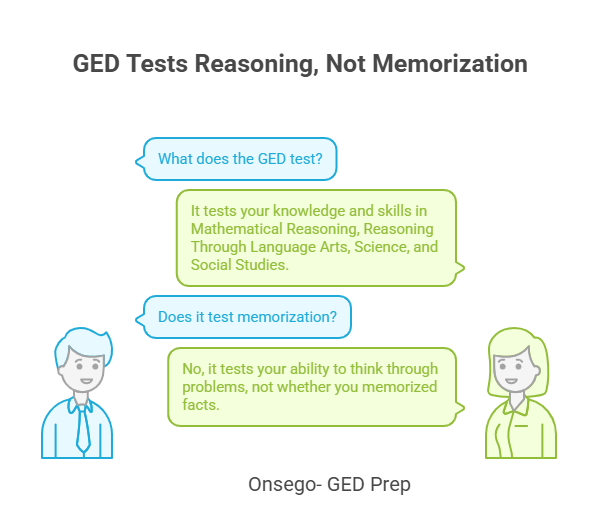
The GED tests reasoning, not memorization
The GED exam has four modular, independent subject tests that measure your knowledge and skills across these four academic fields:
- Mathematical Reasoning (Math)
- Reasoning Through Language Arts (Reading and Writing combined)
- Science
- Social Studies
Notice the word “reasoning” appears in two out of four tests. That’s intentional.
How Fast Could You Get Your GED?
Take an 8-question quiz
The GED tests whether you can think through problems, not whether you memorized facts at the 10th-grade level.
What this means for you
Here are a few examples: you’ll get a chart showing unemployment rates by education level. You need to interpret what it means. You don’t need to memorize unemployment statistics.
You’ll get a passage about photosynthesis. You need to understand the process. You don’t need to memorize chemical formulas.
You’ll see two articles with opposing views. You need to identify the arguments. You don’t need to know who wrote them.
Pass Your GED in 2 months
Short Video lessons | Practice tests | Easy Math with a Calculator
This is good news. Reasoning is easier to learn than memorizing 1,000 facts.
Mathematical Reasoning: What to study
What IS tested
- Basic arithmetic: Fractions, decimals, percentages, ratios
- Word problems: Real-world scenarios with numbers
- Basic algebra: Solving for x, working with expressions
- Geometry: Area, perimeter, volume of basic shapes
- Data interpretation: Reading graphs, charts, and tables
- Basic statistics: Mean, median, mode
What you can SKIP
- Advanced algebra: Logarithms, complex polynomials
- Trigonometry: Sinus, cosinus, tangens (not on the test)
- Calculus: Derivatives, integrals (not on the test)
- Proofs: Geometric or algebraic proofs
- Obscure formulas: You get a formula sheet for what you need
Where to focus your time
- Word problems (40% of the test): Practice turning real situations into math
- Fractions and decimals: These appear everywhere
- Reading charts and graphs: At least 20% of questions involve visual data
- Basic algebra: Solving for x shows up constantly
Examples of what you DON’T need
- You don’t need to memorize the quadratic formula: It’s on your formula sheet
- You don’t need to know the Pythagorean theorem by heart: It’s on your formula sheet
- You need to know WHEN to use these formulas, not memorize them
Reasoning Through Language Arts: What to study
What IS tested
- Reading comprehension: Understanding passages
- Identifying arguments: Main point, supporting evidence
- Grammar and mechanics: Sentence structure, punctuation
- Writing an essay: (the 45-minute GED extended response)
- Editing text: Fixing errors in writing
What you can SKIP
- Vocabulary memorization: No “define this word” questions
- Literary terms: You don’t need to know “metaphor” or “alliteration”
- Poetry analysis: Not on the test, Shakespeare: Not tested
- Book reports: Not required
Where to focus your time
- Understanding main ideas in passages (30% of the test)
- Identifying evidence that supports claims (25% of the test)
- Basic grammar rules: Subject-verb agreement, commas, apostrophes (25% of the test)
- Writing practice essays with a clear thesis and examples (20% of the test)
Examples of what you DON’T need
- You don’t need to know the difference between a simile and a metaphor
- You don’t need to identify “rising action” or “climax” in stories
- You need to understand what the author is arguing and why
Science: What to study
What IS tested
- Reading scientific passages and interpreting them
- Understanding experiments: Hypothesis, methods, conclusions
- Reading charts, graphs, and diagrams
- Basic life science concepts: Cells, genetics, ecosystems
- Basic physical science: Energy, motion, atoms
- Earth science: Weather, geology, space
What you can SKIP
- Memorizing the periodic table: You don’t need element names
- Complex chemical equations: Not tested
- Advanced physics formulas: Not required
- Latin names for species: Not tested
- Detailed anatomy: Beyond basic organs
Where to focus your time
- Reading and interpreting scientific texts (40% of the test)
- Understanding experimental design: What makes a good experiment? (30% of the test)
- Basic concepts in life, physical, and earth science (30% of the test)
- Reading diagrams and charts (appears throughout)
- Read also our page with 10 study tips to pass the GED science test
Examples of what you DON’T need
- You don’t need to memorize “mitochondria form the powerhouse of the cell.”
- You don’t need to know Newton’s three laws word-for-word.
- You need to read a passage about cell energy and answer questions about what you just read.
Social Studies: What to study
What IS tested
- Reading historical and social science passages
- Understanding cause and effect in history
- Reading maps, timelines, and political cartoons
- Basic U.S. government: Three branches, Constitution, rights
- Basic economics: Supply and demand, incentives
- U.S. history themes: Major events and their impact
What you can SKIP
- Memorizing dates: You don’t need to know “1776” or “1865”
- Memorizing names: No “who was president in 1850?” questions
- World geography: Beyond basic map reading
- Detailed world history: Focus is on U.S. history
- State capitals: Not tested
Where to focus your time
- Reading passages about history, government, and economics (40% of the test)
- Understanding cause and effect: Why did this event lead to that result? (30% of the test)
- Basic U.S. government structure (15% of the test)
- Reading visual information: Maps, charts, political cartoons (15% of the test)
Examples of what you DON’T need
- You don’t need to memorize which year the Civil War ended
- You don’t need to know all 27 Constitutional amendments
- You need to read a passage about the Civil War and answer questions about its causes and effects
The smart strategy: Test first, study second
Here’s what most people do wrong
They buy a GED book and study everything equally. Math, reading, science, and social studies, and they study 2 hours per subject per week.
This wastes time. You might be strong in reading but weak in math. Why give them equal time?
The smarter approach
Take a practice test for each subject first. See where you score.
Study only what you’re weak in. Skip what you already know.
Focus 80% of your time on your weakest subjects. That’s the fastest way to get a GED!
Example
You take practice tests. Your scores are:
- Reading: 170 (the passing score is 145, you’re ready)
- Social Studies: 155 (passing score 145, you’re close)
- Science: 140 (need 5 more points)
- Math: 120 (need 25 more points)
Your study plan
- Reading: 0 hours (you’re ready, take the test)
- Social Studies: 5 hours total (light review)
- Science: 10 hours total (moderate focus)
- Math: 30 hours total (heavy focus)
Total: 45 hours instead of 120 hours of equal studying
How Onsego shows you exactly what to study
When you start preparing for your GED with Onsego, you take practice tests. The system analyzes your results.
It shows you
- Which topics you master (skip these)
- Which topics you’re close on (light review)
- Which topics need heavy work (focus here)
Example of what Onsego tells you
Math Practice Test Results:
- Fractions: 90% correct (you’re ready, skip to review only)
- Word problems: 45% correct (STUDY THIS, it’s 40% of the test)
- Basic algebra: 70% correct (light practice needed)
- Geometry: 80% correct (light review)
The system creates your personalized study plan. You spend your time where it matters.
What this looks like in practice
- Week 1: Take all four practice tests (4 hours total)
- Week 2-3: Focus on your weakest subject (10-15 hours)
- Week 4-5: Medium focus on second-weakest subject (8-10 hours)
- Week 6: Light review of third subject (3-5 hours)
- Week 7-8: Take real GED tests, starting with your strongest
Total study time: 25-35 hours over 8 weeks
Compare this to studying everything equally for 120+ hours.
Real-world example: Marcus studied smart, not hard
Marcus took Onsego practice tests:
- Math: 165 (strong, he works in construction)
- Reading: 160 (strong, he reads a lot)
- Science: 135 (weak)
- Social Studies: 130 (very weak)
Marcus spent 3 weeks studying only Science and Social Studies. He spent 0 hours on Math and Reading.
He passed all four tests in 5 weeks total.
Marsus said, “I didn’t waste time studying stuff I already knew. I focused on my gaps. I was done in a month.”
How to identify YOUR specific gaps
Step 1
- Take a practice test for each subject
- Cost: Free with Onsego trial
- Time: 90 minutes per test (6 hours total)
Step 2
- Review your results
- See which specific topics you missed
- Not just “you got 60% in math,” but “you missed 8 out of 10 word problems”
Step 3
- Study only your gaps; focus on specific weak topics
- Skip what you already know; Watch video lessons for your weak areas only
Step 4
- Practice those specific topics
- Do 20-30 practice questions on word problems
- Do 10-15 questions on other weak topics
- Skip practice on topics you’ve mastered
Step 5
- Retest: take another practice test after 2 weeks
- See if your weak topics improved
- Adjust your study plan
The formula: Test → Identify gaps → Study gaps → Retest → Repeat
What you get with Onsego
- Diagnostic practice tests that show your exact gaps
- Video lessons for only the topics you need
- Unlimited practice questions focused on your weak areas
- AI tutor when you get stuck on specific problems
- Progress tracking that shows improvement over time
- Clear signal when you’re ready for the real test
- Many free bonuses to help you succeed fast and easily
- Plans from $79 to $199, depending on your timeline.
- Cost: $223-$343 total (Onsego + GED testing fees in most states)
The biggest mistake people make
They buy a 500-page GED book. They try to read all 500 pages. They study everything equally.
They spend 3 months studying topics they already know.
They get burned out and quit.
The smart approach
- Find your gaps in week 1
- Study only those gaps for weeks 2-6
- Take the test in weeks 7-8
- Total time: 8 weeks instead of 6 months
Bottom line
You don’t need to relearn four years of high school. You need to fill your specific knowledge gaps.
The four GED subtests assess your reasoning and problem-solving skills, not memorization of obscure facts.
Most people waste 60-70% of their study time on topics they already know.
Take practice tests first. Identify your gaps. Study only what you’re weak in. Skip the rest.
Onsego shows you exactly what to study and what to skip. Most students finish in 8-12 weeks by focusing only on their gaps.
Stop studying everything. Start studying smart.
Start your free trial with Onsego today. Take practice tests. See your gaps. Build your personalized study plan.
Last Updated on September 8, 2026