
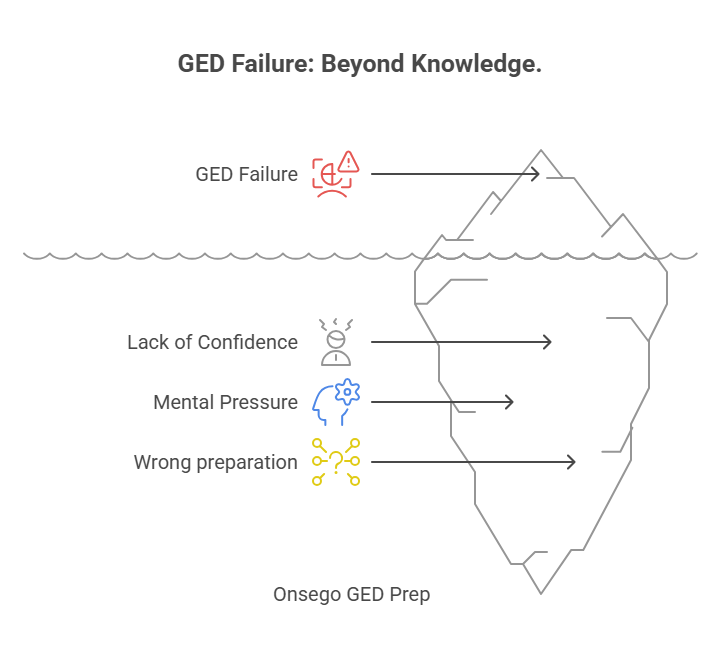
Many people fail the GED because they don’t know this one truth: passing requires confidence as much as knowledge.
The GED isn’t just a knowledge test. It’s a mental game. You need to think clearly under pressure. You need to believe you can figure out unfamiliar questions.
Most GED prep programs teach you facts and formulas. But they skip the confidence part. They accidentally make you feel stuck, stupid, and ready to quit.
Get your GED Diploma Quickly
With Onsego, it’s simple and easy
Research proves this: confidence predicts test performance almost as much as knowledge does.
Here’s what kills your confidence during GED prep and how to avoid it.
The hidden truth: The GED tests reasoning under pressure
The GED isn’t just a knowledge test. It’s a reasoning test that you take when you’re nervous.
How Fast Could You Get Your GED?
Take an 8-question quiz
You need two things to pass:
- Ability to think through problems
- Confidence to believe in your skills
Most prep programs focus only on #1. They ignore #2.
What kills your GED confidence
Negative wording
Words carry a little package of power that influences you independently of the context.
Some words have hidden negative power, for example:
Pass Your GED in 2 months
Short Video lessons | Practice tests | Easy Math with a Calculator
- “You have to…” sounds more negative than “let’s use this approach.”
- “It’s difficult…” prepares you for something hard, but saying “It can be challenging…” says you are able to solve it, let me show you how
- “Repeat until you understand” is a trap, but “skip for now and come back later” is moving forward
Everything can be reframed as a learning opportunity. But if the GED prep you use doesn’t understand it, they might make you feel like a failure. Your confidence slowly dies.
Onsego GED prep is rooted in positive psychology principles, and every word matters to us.
We listen to you, and if something is not resonating with you, we will figure out a way to change it.
No reasoning learning
Yes, knowledge and facts are important, but they need to serve as a basis for reasoning.
Many GED programs teach you to memorize facts. But the GED shows you questions phrased differently than you studied. If you only memorize, you panic.
The GED test is designed to assess whether you can apply your knowledge to new situations. You see a question you’ve never encountered before. Can you figure it out using reasoning?
Onsego teaches you reasoning strategies so you can handle any question format. You learn elimination techniques so you can always find a way to answer every question. If you follow this process, you can pass the GED fast.
No visible progress
Seeing and feeling your progress is very important. If you can’t look at it or worse, can’t move forward without reaching some imaginary level, you feel stuck.
When you feel stuck for weeks, your confidence dies, and motivation disappears.
Real-world example: Why Sarah quit her GED class
Sarah studied for the GED twice a week for 8 weeks with books.
She studied the same social studies section for 4 weeks straight, but couldn’t pass the review test and couldn’t move to the next part.
She felt stuck. She felt dumb. She stopped learning. 2 months later, she joined Onsego and passed the GED Social Studies test in 3 weeks.
Sarah says, “I thought I was the problem. Turns out the method was the problem.”
What actually builds confidence (backed by psychology)
GED Confidence comes from forward movement
Your brain needs to feel progress. Moving forward builds the belief “I can do this.”
Getting stuck in one place builds the belief “I can’t do this.”
Even if you’re not perfect, moving forward maintains motivation.
Confidence comes from small wins
You don’t build confidence by passing one giant test. You build it through 100 small successes.
“I understood that video.” “I got 4 out of 5 practice questions right.” “I figured out that word problem.”
Small wins add up to big confidence.
Confidence comes from knowing HOW to think, not WHAT to think
When you know the reasoning process, unfamiliar questions don’t scare you.
“I’ve never seen this exact question, but I know how to approach it.”
That’s confidence. That’s what passes tests.
Confidence comes from familiarity
Taking different types of practice tests helps you feel confident. “I’ve done this 20 times in practice. This is familiar.”
Familiarity removes fear.
How Onsego builds confidence differently
1. You always move forward
Onsego shows you progress. Every time you watch a video or take a short quiz, your progress is saved automatically.
Why this works: Your brain sees forward movement. “I’m making progress. I’m learning.” Confidence builds.
2. We talk to you using power words
Every communication within the Onsego platform is built on a positive approach. We reframe not-perfect answers into learning opportunities.
You see success. Small wins build confidence.
3. You learn reasoning, not memorization
Onsego teaches you:
- How to read what the question is actually asking
- How to eliminate obviously wrong answers
- How to make your best guess when unsure
- How to stay calm when a question looks unfamiliar
Why this works: On test day, you see an unfamiliar question. You don’t panic. “I know how to approach this even though I’ve never seen this exact problem.” That’s confidence.
Traditional programs make you memorize answers. On test day, you see different phrasing. You panic. “I don’t know this one.” Confidence crashes.
4. Video explanations show the thinking process
Onsego practice tests include video explanations that walk through:
- What is this question asking?
- Which answers can we eliminate immediately?
- What’s the logical path to the right answer?
Why this works: You see HOW to think through problems. You copy that process. It becomes familiar. “I can do this.”
Traditional programs show: “The answer is B.” No explanation of why or how. You don’t learn the thinking process.
5. You get instant help when stuck
At 11 pm, you’re stuck on a problem. You click the AI tutor. You type your question. You get an explanation in 30 seconds. You keep moving.
Why this works: You never stay stuck long enough to lose confidence. “I was stuck, I got help, I figured it out.” Small win. Confidence builds.
Traditional programs: You get stuck. No one to ask. You stay stuck for days. “I’m too dumb for this.” Confidence dies.
6. The practice tests feel like the real test
By the time you take the real GED, you’ve done 50+ practice questions in the same format, same timing, same style.
Why this works: Test day feels familiar, not scary. “I’ve done this before.” Confidence stays high. This is the way to get your GED fast!
Traditional programs use practice formats that differ from the real test. On test day, that feels unfamiliar. “This looks harder than I expected.” Confidence drops.
Real-world example: How James built confidence in 8 weeks
James tried GED books for 3 months. He scored 50-60% on practice tests. He felt stuck. He quit.
Then he started Onsego.
Week 1:
- Took practice test, scored 55% in math
- System showed: “You got 11 out of 20 right. Here are your strong areas.”
- He felt: “I’m not terrible. I have a foundation.”
Week 2-4:
- Watched video lessons
- Did practice questions, scored 60%, then 65%, then 70%
- He felt: “I’m improving. This is working.”
Week 5:
- Got stuck on algebra word problems
- Used Onsego’s AI tutor at midnight
- Got an answer, kept moving
- He felt: “I can figure this out even when stuck.”
Week 6-7:
- Practice tests felt familiar
- Scored 75%, then 80%
- He felt: “I’m ready for this.”
Week 8:
- Took the real GED math test
- Passed with 155 – check here -> to learn more about GED scoring and scoring ranges
- He felt: “I knew I could do it.”
James says, “My knowledge didn’t change that much from month 3 of books to week 8 of Onsego. My confidence changed completely.” Onsego is a super-fast way to earn your GED.
What destroys confidence vs what builds it
Here’s the pattern that kills confidence:
Low confidence = Feeling stuck + seeing only failures + fear-based messaging + memorizing without understanding + unfamiliar test format
Here’s the pattern that builds confidence:
High confidence = Moving forward + seeing small wins + supportive system + learning reasoning + familiar practice
Same student. Same material. Different approach. Different outcome.
Why does this matter on test day
Test day: You see a question that looks unfamiliar.
Low confidence response: “I don’t know this. I’m going to fail. I should have studied more.” (Panic, wrong answer)
High confidence response: “I haven’t seen this exact question, but I know how to approach it. Let me eliminate the obviously wrong answers and reason through it.” (Calm, right answer)
That’s the difference confidence makes.
What you get with Onsego
- Video lessons that show reasoning process (not just answers)
- Practice questions with positive feedback (showing what you got right)
- Forward progress always (no blocking until “perfect”)
- AI tutor for instant help (never stay stuck)
- Familiar test format (practice = real test)
- Progress tracking that shows improvement (not just failures)
- Many free bonuses that help you succeed
- Pass guarantee (confidence in the system)
Bottom line
Passing the GED requires knowledge AND confidence. If you feel that your GED prep kills your confidence, change it.
Research shows confidence predicts performance as much as knowledge.
Build both. Pass the test.
Start your free trial with Onsego today. Build knowledge and confidence together.
Last Updated on September 15, 2026