
The GED exam offers adults who didn’t complete high school the opportunity to earn an equivalency diploma, and in this post, we discuss how popular the GED test is.
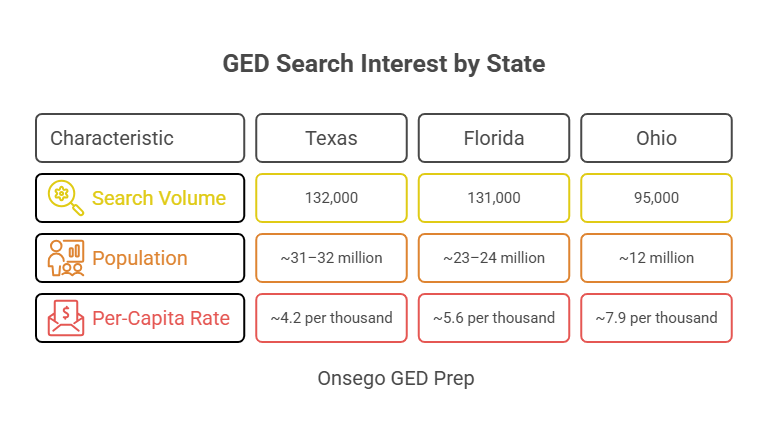
According to approximate annual Google search volumes for GED-related terms (e.g., “GED,” “GED test,” etc.) in each state, the 3 states with the highest GED interest are Texas, Florida, and Ohio.
- Texas has the highest raw search volume (132,000), which aligns with its much larger population (~31–32 million).
- Florida is very close behind (131,000), despite a smaller population (~23–24 million), suggesting slightly higher per-person interest in the GED there.
- Ohio has noticeably lower volume (95,000) and the smallest population (~12 million).
Key insights
Ohio shows the highest relative per-capita interest in GED-related searches (~7.9 per thousand).
Get your GED Diploma Quickly
With Onsego, it’s simple and easy
This indicates that a larger share of the Ohio population is searching for GED information than in the other two states.
This could reflect factors such as educational needs, workforce trends, or state demographics.
Florida ranks second (~5.6 per thousand), with a relatively high absolute volume despite not having the largest population—possibly tied to its influx of working-age migrants or adults pursuing credentials.
How Fast Could You Get Your GED?
Take an 8-question quiz
Texas has the lowest per-capita rate (~4.2 per thousand) among the three, even though it leads in total GED-related searches. The state’s sheer population size drives the high raw number.
See also this page with information about GED online by state.
These patterns align with analyses of GED interest data, where Ohio unexpectedly ranks high in relative popularity despite lower total searches, while Texas and Florida dominate absolute searches due to their size.
The high number of Google searches in Florida and Texas doesn’t come as a surprise — these states have populations of 23+ million and some 31 million, respectively — but the number of searches for GED in Ohio is quite surprising, says Steve Gory, the EdTech expert at Onsego.
In the U.S., around 11% of the working population didn’t complete high school and don’t have an equivalent diploma.
In order to receive their GED diplomas, students must pass four independent subject tests.
Two nationally available High School Equivalency exams
The GED (General Education Development) exam is one of two nationally available High School Equivalency exams for people lacking a high school diploma. The other option is the HiSET (short for High School Equivalency Test).
People without a high school diploma or its equivalent have far fewer opportunities for sustainable employment and economic self-sufficiency.
The Bureau of Labor Statistics estimates that high school or GED graduates earn, on avarage, at least $9,800 more annually than workers without a secondary education credential.
The developer and publisher of the GED exam, GED Testing Service, is a collaboration between the American Council on Education, ACE, and the world’s largest publisher of educational tests, Pearson VUE.
Students who pass the four GED subtests will be awarded a GED High School Equivalency Diploma by their states.
The four GED subtests
The four GED tests are independent modules that students can take one at a time and in their preferred order.
The four subtests assess a candidate’s proficiency in the academic subject fields of
- Mathematics
- Language Arts (Reading & Writing combined)
- Social Studies
- Science
- Check here to learn all about the GED scoring ranges
The HiSET exam has separate Language Reading and Language Writing subtests, totaling five independent subtests.
The National Association of State Directors of Adult Education (NASDAE) estimates that over 24 million Americans ages 18-64 lack a high school diploma, meaning a stunning 11% of the U.S. workforce doesn’t have a secondary degree!
America’s two high school equivalency tests (GED and HiSET) are rigorous assessments that measure knowledge at a level similar to that of high school graduates.
While the GED exam is fully computer-based, the HiSET is available in computer-based and paper-based formats in most states where the HiSET exam is used.
Several states offer both exams for adult learners seeking to earn a high school equivalency diploma.
Both the HiSET and GED exams are available at official state-certified testing centers and online.
To qualify for online GED testing, candidates are required to first attain passing scores (in the “green” range) of the official GED practice test, GED Ready.
Onsego students with an Advantage Plan receive four GED Ready Vouchers for free as part of their plans, a wondeful $32 value bonus.
Last Updated on September 13, 2026